The Hidden Danger Nobody Talks About When Seniors Move
This morning Steven and I went to check on a client we moved yesterday. She had left us a check for more than she owed. We could not reach her by phone — her lines had not yet been connected to her new room — so we went in person. That is not something we were willing to leave unresolved. Accepting a payment we did not earn without authorization is not how we operate.
What we found when we got there was something much bigger than an overpayment.
She told us how distressed she had been since the move. Not because anything went wrong. Not because we did anything poorly. But because her new unit was a mirror image of the one she left. Same layout, everything flipped. And that small spatial difference — something most people would not think twice about — had her completely disoriented.
Her husband has mobility issues. Which means the stakes of that disorientation are doubled. Every unfamiliar threshold, every misremembered step, every reaching for something that is not where his body expects it to be — carries a weight for their family that most people never fully appreciate until they are living it.
I did not just understand what she was describing. I have lived it from the other side.
What a CNA sees that most people miss.
I spent twenty years as a CNA in memory care, hospice, and veteran facilities before I ever moved a single piece of furniture professionally. In that time I watched spatial disorientation do things to people that most families would never connect to a move.
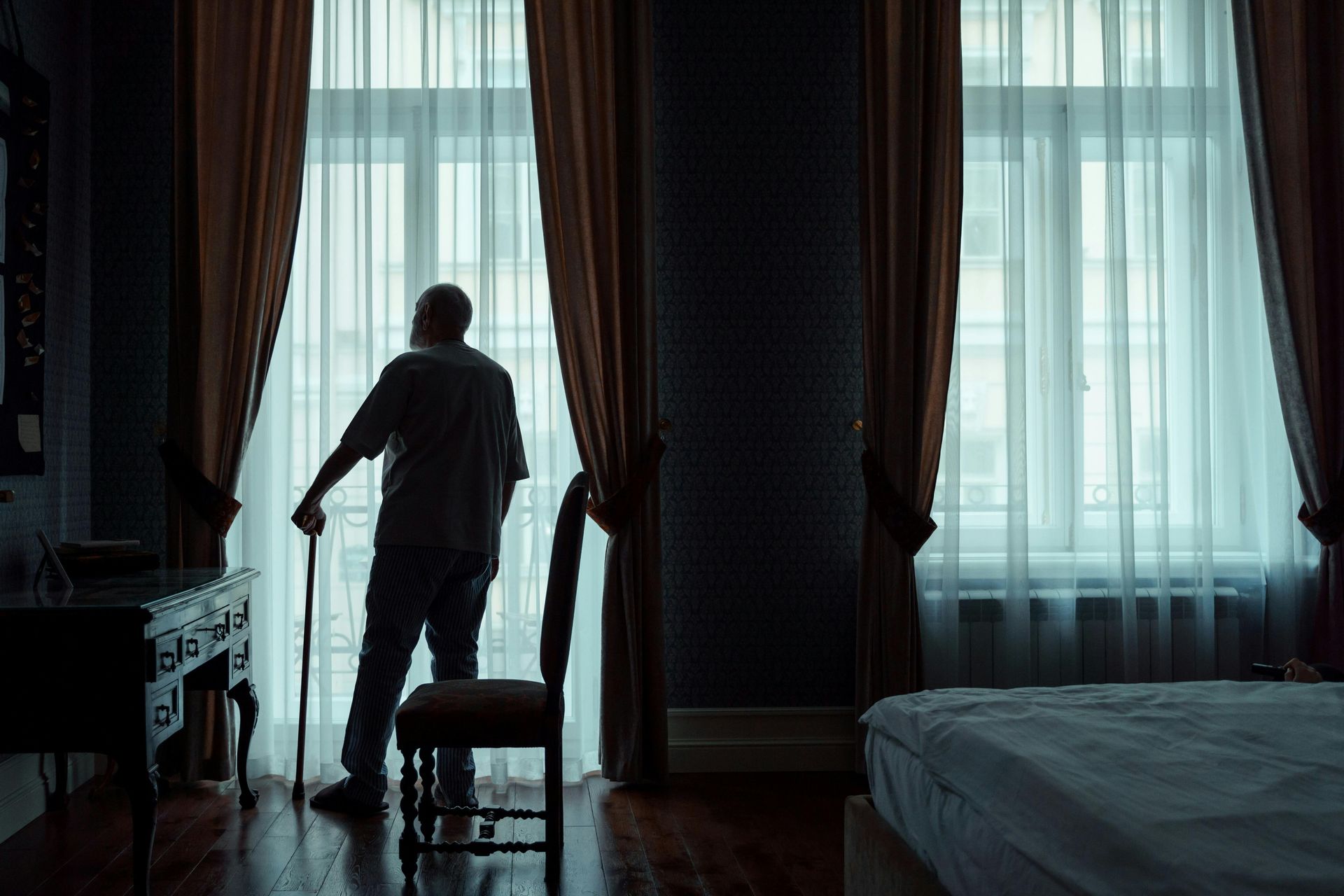
I once watched a resident transfer from one end of a hallway to the other — the opposing side, a mirror of where she had been. A few dozen feet. Same building. Same staff. Same faces. And that tiny shift in her spatial environment changed everything. She reached for walls that were not there. She turned toward doors that were not where her body expected them to be. She woke up at 2am and her feet hit the floor and her brain told her the bathroom was to the left when it was now to the right.
That moment — that split second of spatial confusion in the dark — is where falls happen.
Not dramatic falls. Not tripping over something obvious. The quiet, invisible falls that happen when a body acts on muscle memory that is no longer accurate.
As a CNA you learn to read the signs. You learn that disorientation is not just confusion. It is a physiological state. When the brain cannot reconcile what it expects to find with what it actually finds, it triggers a stress response. Cortisol rises. Reaction time slows. Balance is compromised. The vestibular system, which governs our sense of spatial orientation and balance, becomes unreliable when the environment no longer matches its internal map. In a younger person this resolves quickly. In an aging brain, particularly one already managing any degree of cognitive decline, it can persist for days or weeks.
And during that window the risk of a fall is dramatically elevated.
When one partner already has mobility challenges that risk compounds for both of them. The able partner is watching, worrying, carrying the mental load of monitoring someone they love while also managing their own adjustment. Caregiver fatigue is real and it begins the moment the truck pulls away.
What actually happens when an older adult falls.
Let me be direct with you because I have seen this trajectory more times than I can count.
A senior wakes up disoriented in a new space. They get up without turning on a light because the light switch is not where they expect it to be. They take three steps toward where the bathroom used to be. Their foot catches on a threshold, a rug edge, a floor transition they have not yet learned. They go down.
What happens next depends on so many variables — how they land, whether they can get up, whether anyone knows to check on them. I have moved people who had fallen and were not found for more than a day. They laid on the floor, injured, unable to reach a phone, unable to call out loudly enough to be heard, waiting. This is not rare. This is not something that only happens to people who were already struggling. It happens to capable, independent seniors in the disorientation window after a move.
Now let me tell you what a hip fracture actually means in clinical terms because I do not think families fully understand it.
A hip fracture in an older adult triggers a cascade. Surgery is almost always required. General anesthesia in an aging body carries its own risks including post-operative cognitive decline — a condition called POCD where patients experience confusion, memory loss, and disorientation that can persist for months and in some cases permanently. The immobility required during recovery leads to rapid deconditioning. Muscle atrophy sets in within days. Blood clot risk rises. Pneumonia risk rises. Pressure injuries begin forming on skin that is no longer getting adequate circulation.
Research consistently shows that 20 to 30 percent of older adults who suffer a hip fracture die within one year of the injury. Not from the fracture itself but from the cascade of complications that follow. For those who survive, a significant portion never return to their prior level of independence.
That is what I think about when I am setting up a bedroom on a move. That is what is in the back of my mind when I make sure the lamp is on the same side of the bed it was on in the old home.
What the body is doing during spatial reorientation.
When we move through a familiar environment we are not consciously navigating. We are running on procedural memory — deeply encoded automatic routines that allow us to walk to the bathroom in the dark without thinking about it. Our feet know the distance. Our hand knows where the wall is. Our body has done this thousands of times and does not need our conscious brain to intervene.
When the environment changes that procedural memory becomes a liability instead of an asset. The body acts on the old map. The new terrain does not match. And in the fraction of a second between expectation and reality, especially in an aging nervous system with slower corrective reflexes, a person can go down before they even register that something is wrong.
This is compounded in seniors who are also managing any degree of neuropathy, which reduces sensation in the feet and makes early detection of an unstable step much harder. It is compounded further by medications — blood pressure medications, sleep aids, pain medications — many of which affect balance and coordination as side effects. And it is compounded by the emotional stress of a move itself, which elevates cortisol and affects cognitive clarity and physical coordination in ways that are real and measurable.
A move is not just emotionally hard on an older adult. It is physiologically hard. And the body's ability to adapt to a new spatial environment is one of the most underestimated challenges in the entire process.
The family dynamics nobody prepares you for.
While we were there this morning our client shared something else. Something I have heard in different forms from so many families and that deserves to be said out loud.
She talked about her children.
The one she expected to step up — the one who had always seemed most capable, most responsible — had pulled back. He was looking at the move, at the facility, at the costs, through a practical and financial lens that felt to her like a business transaction rather than a family moment. He did not understand what the move into a facility actually involves — emotionally, logistically, financially — and that misunderstanding had created distance at the exact moment she needed closeness.
And then the child she had not expected — the one who had perhaps seemed less equipped for this kind of responsibility — stepped forward in a way that surprised everyone. Including themselves.
This is not unusual. Not even close. I have seen it so many times that I have stopped being surprised by which child shows up and which one struggles. A move into a senior living facility surfaces things in families that have nothing to do with the move itself. Old dynamics. Old wounds. Different understandings of what love looks like in a crisis. Different tolerances for vulnerability and need.
If you are the adult child reading this please hear me. There is no right way to feel about your parents moving into a facility. Grief, guilt, relief, anger, love — all of it can be present at the same time and all of it is valid. What matters is that you show up in whatever way you are capable of showing up. And if you are struggling to understand the decision or the costs or the logistics, ask questions rather than pulling away. Your parents need your presence far more than they need your answers.
What moving into a facility actually means — and what it does not mean.
Our client also talked about something that moved me deeply. She talked about the other residents.
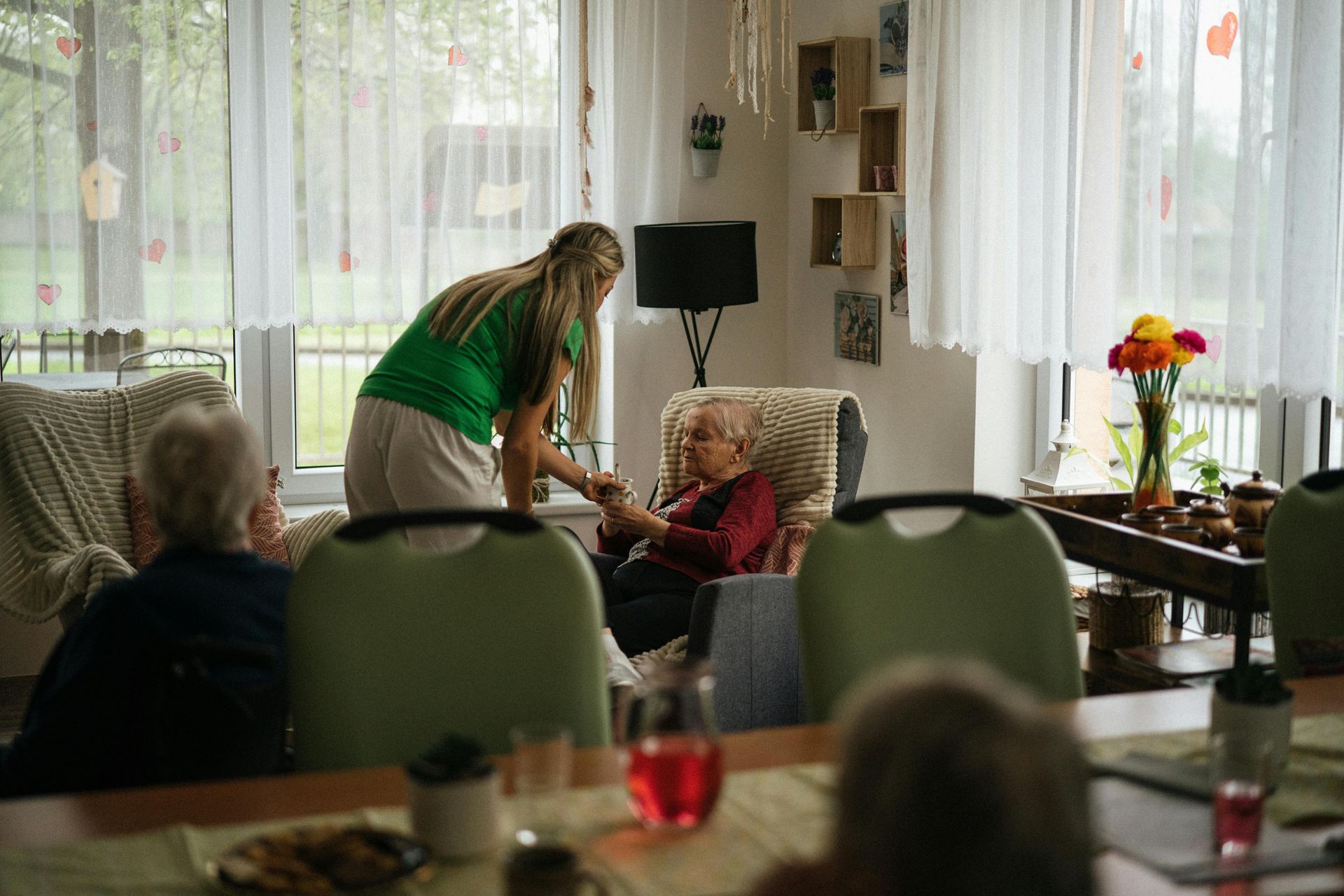
At her first meal in the dining room she found herself in conversation with people who had been exactly where she was — scared, disoriented, grieving the home they had left, uncertain about what came next. And they told her it gets easier. They told her she would find her footing. They told her what they wished someone had told them.
She found community within hours of arriving. A community of people who understood without explanation. Who did not need the backstory because they had lived their own version of it.
This is something adult children often cannot see from the outside. They see a parent moving into a facility and they feel like they have failed somehow. Like they should have found another way. Like this is the beginning of the end.
But for many seniors — most seniors, in my experience — moving into a facility is an act of extraordinary courage and self-determination. It is a choice to age with dignity. To not burden the people they love with the weight of their daily care. To maintain a level of independence and community and purpose that staying home, increasingly dependent, could not have given them.
It is hard for children to see because love makes it hard to see. But the perspective from inside the facility is often very different from the perspective outside it. The residents are not waiting to die. Many of them are living — genuinely living — in a way that was not possible in the isolation of a home that had become too much to manage.
Honor that. Even when it is hard. Even when it hurts.
What you can do — starting today.
Set up the new space to mirror the old one as precisely as possible. This is something we do intentionally on every senior move. The lamp goes on the same side of the bed. The favorite chair faces the same direction relative to the window. The path from the bed to the bathroom is as unobstructed as possible. The body navigates by memory. The closer the new environment matches the old one the faster the brain can build a new accurate map.
Night lights are not optional. They are clinical necessities. Every hallway. Every bathroom. The path from the bed to the toilet at 2 in the morning in an unfamiliar space is one of the highest risk moments in a senior's entire day. A motion-activated night light in every key location costs very little and the return on that investment is measured in safety.
Walk through the new space with your loved one before you leave — slowly, deliberately, out loud. Say it as you go. The bathroom is here. The light switch is on this side. The step down into the living room is right here. You are giving their brain an advance map. You are reducing the degree to which they have to figure it out alone in the dark.
Remove floor hazards before they arrive. Throw rugs. Threshold strips with any elevation. Electrical cords that cross walking paths. These are invisible dangers to someone whose spatial memory is still recalibrating.
Check their medications with their physician before the move if possible. If they are on anything that affects balance, coordination, or blood pressure — and many seniors are on several such medications simultaneously — their doctor should know a significant environmental change is coming. There are sometimes temporary adjustments that can reduce fall risk during the adaptation period.
If your loved one is moving into a facility — ask these questions before they arrive.
This is something families do not always understand and it is critically important. In independent living your family member may not have staff members with consistent eyes on them. They have their own apartment. Their own door. Their own routine. And if they fall at 9pm on a Tuesday nobody may know until the next morning or longer.
Before your loved one moves into any level of care ask these questions directly and get real answers.
How often will someone have eyes on them? Not a general policy answer. A specific, practical answer about what a typical day actually looks like.
What is the protocol if they do not show up for a meal? Is there a check-in system? Who triggers it and how quickly?
Is there a call bell or pendant system? One of the senior communities we work closely with provides every resident with a call bell on a necklace. It is ingenious in its simplicity because it goes where the person goes. They do not have to reach for something across the room or remember where they put it. Ask about this at every facility you consider and if it is not provided ask whether you can arrange one independently.
What is the response time if a call bell is activated? A pendant that calls for help is only as good as the response on the other end.
The tools that can close the gap for seniors living independently.
Medical alert systems with automatic fall detection have become remarkably sophisticated. Devices from companies like Life Alert, Medical Guardian, and Bay Alarm Medical can detect a fall and automatically contact emergency services even if the person cannot press a button or call out. Apple Watch and certain other smartwatches have built-in fall detection that calls emergency services if the wearer does not respond after a detected fall.
Motion sensor check-in systems are newer but increasingly accessible and genuinely effective. Small sensors placed throughout the home detect movement patterns and can alert a family member if the normal daily routine is broken. If your mother is always moving around her kitchen by 7am and nothing has moved by 9am you get a notification. It is not surveillance. It is a safety net.
Door and refrigerator sensors are a simple and low-cost addition. A sensor on the refrigerator that notifies a family member if it has not been opened by a certain time of day is a basic but meaningful check that someone is up and functioning. These devices cost less than a dinner out and the peace of mind they provide is immeasurable.
Video check-ins are something many families are already using but underutilizing. A brief daily video call is not just connection — it is a wellness check. You can see how they look. You can hear how they sound. You can notice when something seems off in a way that a text message will never capture.
A note from the CNA in me to the family reading this.
Every family I have ever worked with — both as a CNA and as a mover — has loved their person deeply and wanted to do right by them. And almost every family has underestimated how hard the first few weeks in a new environment would be. Not because they were not paying attention. Because nobody told them what to look for.
The move going well does not mean the adjustment will be easy. A beautiful new apartment does not eliminate the physiological reality of spatial disorientation. A kind and competent facility does not replace the need for family eyes during the transition window.
The first two to four weeks after a senior moves are the highest risk period. Visit more during that window than you think you need to. Call more. Stop by unexpectedly. Notice how they are moving through the space. Notice whether they seem hesitant, whether they are reaching for things that are not there, whether they are sleeping more than usual or seem more confused than baseline.
Those are the signs. And catching them early is the difference between an adjustment period and a crisis.
And if you are struggling with your feelings about this move — if you feel guilty or lost or like you should have done more — please be gentle with yourself. This is one of the hardest things a family goes through. There is no perfect way to do it. There is only showing up with love and doing your best with what you know.
Why we went back this morning.
We checked on our client not because something went wrong but because that is what we do. We care about what happens after the truck leaves. We always have.
She was safe. She was adjusting. She had already found people at her dining table who understood exactly what she was carrying. And she was grateful that someone showed up to ask how she was doing.
That is the job. Not just the move. Everything that comes with it.
If you have questions about how to prepare a new space for a senior move, what to watch for during the adjustment period, or what to ask a facility before your loved one arrives — we are always happy to talk it through. No pitch. Just real information from someone who has been on both sides of this.
With care,
Brie Grant, CNA
S.B. Taylor Moving